Your security can be strong and still be undone by a supplier. Map who can access what, ask the right questions, put responsibilities in writing and keep supplier access under control.
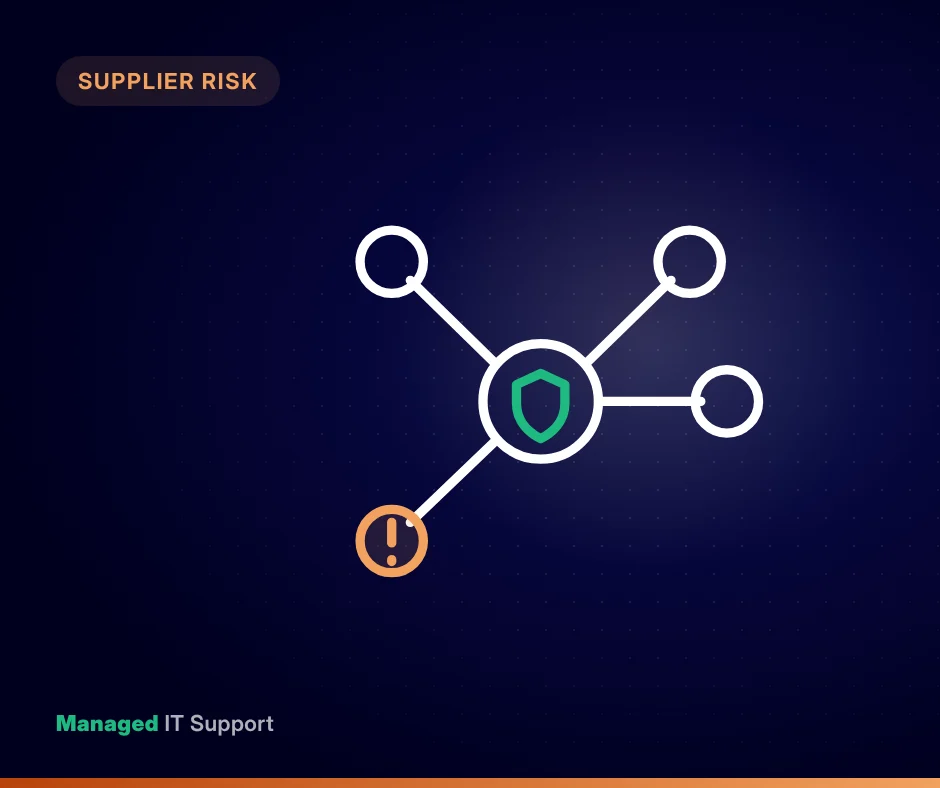
Most UK SMEs rely on other organisations to keep the business moving. Your accountant may run payroll. A software provider may hold customer records. An IT partner may administer Microsoft 365. A payment provider or facilities company may connect to systems that matter more than they first appear.
That convenience creates dependency. If a supplier is compromised, unavailable or can't explain what happened, you may face delays, lost access, a data protection question or awkward conversations with customers. The supplier doesn't have to be "bad" for that to happen. The risk can come from unclear access, outdated systems, weak recovery or a subcontractor you didn't know about.
The answer isn't to avoid suppliers. It's to understand the relationships that matter and manage them proportionately. It's also increasingly what larger customers expect: our piece on the Cyber Security and Resilience Bill explains why supply-chain security is moving up the agenda.
You don't need a governance project. A spreadsheet will do, with:
This quickly separates low-impact suppliers from the ones that need a closer look. A stationery supplier probably has no technical access. Your payroll provider handles sensitive personal data on a fixed date every month. Your IT provider has privileged access across the business. Those don't deserve the same assessment.
The NCSC recommends understanding your whole supply chain, including subcontractors, and matching protections to the risk. For an SME, that starts with knowing who can access what, and who you'd call if something went wrong.
Long questionnaires often go unread. Focus on questions that affect your real exposure:
The answer should be specific enough to understand the control, not "we take security seriously". If a supplier can't answer a reasonable question, record it as something to resolve rather than quietly accepting it.
The contract should make clear what the supplier does and what stays with you, especially where an IT provider or software partner has access to your systems. It should cover:
A simple responsibility matrix stops "the supplier handles IT" being read as "the supplier handles every security, backup, compliance and recovery task". And don't rely on the contract alone: if a service is badly configured in your environment, you'll still feel the impact. Review the setup as well as the paperwork.
Supplier access should be limited to what's needed, for as long as it's needed:
Temporary access should have an agreed start and end. Ongoing privileged access should have a reason, and be reviewed. Access that made sense two years ago may not be needed now.
A supplier can have strong security and still have an outage. Ask how the service and your data would be recovered: expected recovery time, how much data could be lost, where backups live and who can reach them. If they manage your backups, ask how often restores are tested and whether results are recorded.
Then think about your own workaround. Could staff keep essential work going if that supplier were down for 24 hours? Do you have an alternative contact, a manual process, or an export of the information you'd need?
Supplier risk changes. A provider may add a subcontractor, move a service or change how remote access works, and you may start putting more sensitive information through the same platform.
Review high-impact suppliers at least once a year and after any significant change or incident; lower-risk suppliers can wait until renewal. Keep a short record of what you asked, what they said, what was agreed and who's following up. A short, current record beats a detailed assessment nobody maintains.
Pick your five most important suppliers and answer four questions for each:
Start with the supplier that combines high access with high business impact. Ask for a review meeting, document responsibilities and agree the next action.
If you'd like a second pair of eyes on supplier access, contracts or recovery arrangements, book a free IT review or email hello@managedtech.uk. It's a good place to start.
Book a free IT review and we'll show you exactly where your current setup is costing you money, leaving you exposed, or slowing your team down. No obligation, no hard sell.